Barcelona Pride 2025
Campaign and Communication System for Barcelona Pride 2025
The Ajuntament de Barcelona (Barcelona City Council) commissioned us to create the campaign and communication system for Orgull Barcelona 2025, with the aim of reinforcing the institutional commitment to diversity, freedom, and the rights of LGBTIQA+ people. Despite a deeply developed conceptual, visual and political approach —with reparative and empowering intent— the proposal was ultimately not implemented.
The brief was based on the claim “the freedom to be”, seeking to portray a proudly diverse Barcelona through real and plural representation of the LGBTIQA+ community. This led us to develop a campaign that rejected stereotypes and placed people and identities at the centre, through an empathetic, direct and human lens. The project addressed two main audiences: LGBTIQA+ individuals and the general (heterosexual) population, aiming to build a narrative that speaks both to those who need representation and to those who must learn to look without bias.
The core of the proposal was collective empowerment and self-affirmation: using the institution not only to celebrate, but to heal, repair and sustain. The campaign therefore combined political messaging, colour linked to the symbols of the movement, and photography as memory and homage. We recovered archival material from key moments —including the first LGBTIQA+ demonstration in the Spanish state, held on La Rambla on June 26, 1977— combining it with contemporary protest imagery to build continuity and present-day relevance. We did not speak only about what we were, but about what we still are, and what must continue to be defended.
The narrative unfolds across three complementary levels. The first uses normative identity labels —gay, lesbian, bisexual, trans, intersex— as institutional visibility. The second reclaims historically violent terms —faggot, dyke, tr***y— transforming insult into pride. The third incorporates an intersectional and migrant dimension, including terms from other geographies such as buzi (Hungary) or trolo (Argentina), acknowledging those who come to Barcelona seeking safety, respect and the right to exist. This framework recognises overlapping violences —racism, sexism, misogyny, classism, ableism— and positions the LGBTIQA+ struggle as inseparable from feminist, anti-racist and anti-capitalist movements.
Language has historically been used as a weapon against dissidence, yet also as one of its strongest tools of resistance. Words created to wound have been reclaimed as collective resilience. Reappropriating an insult reverses power —it transforms aggression into identity, turning the wound into memory and belonging. This linguistic and emotional dimension was fundamental to the message architecture.
The central concept, “We are and will remain a reason for pride”, encapsulates the campaign’s position. We are affirms, we will be resists and projects forward, and a reason for pride transforms imposed shame into shared strength. More than a festive slogan, it is a manifesto-sentence capable of repairing and shaping future.
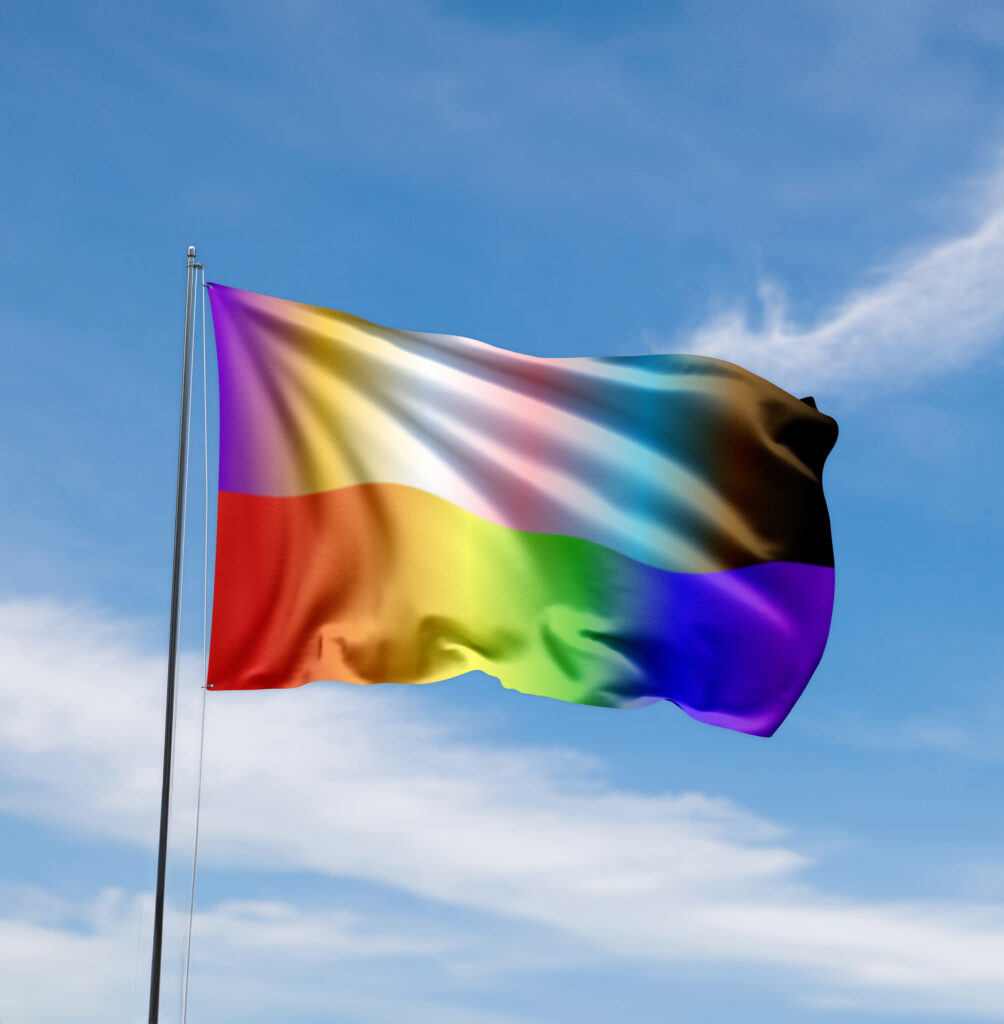
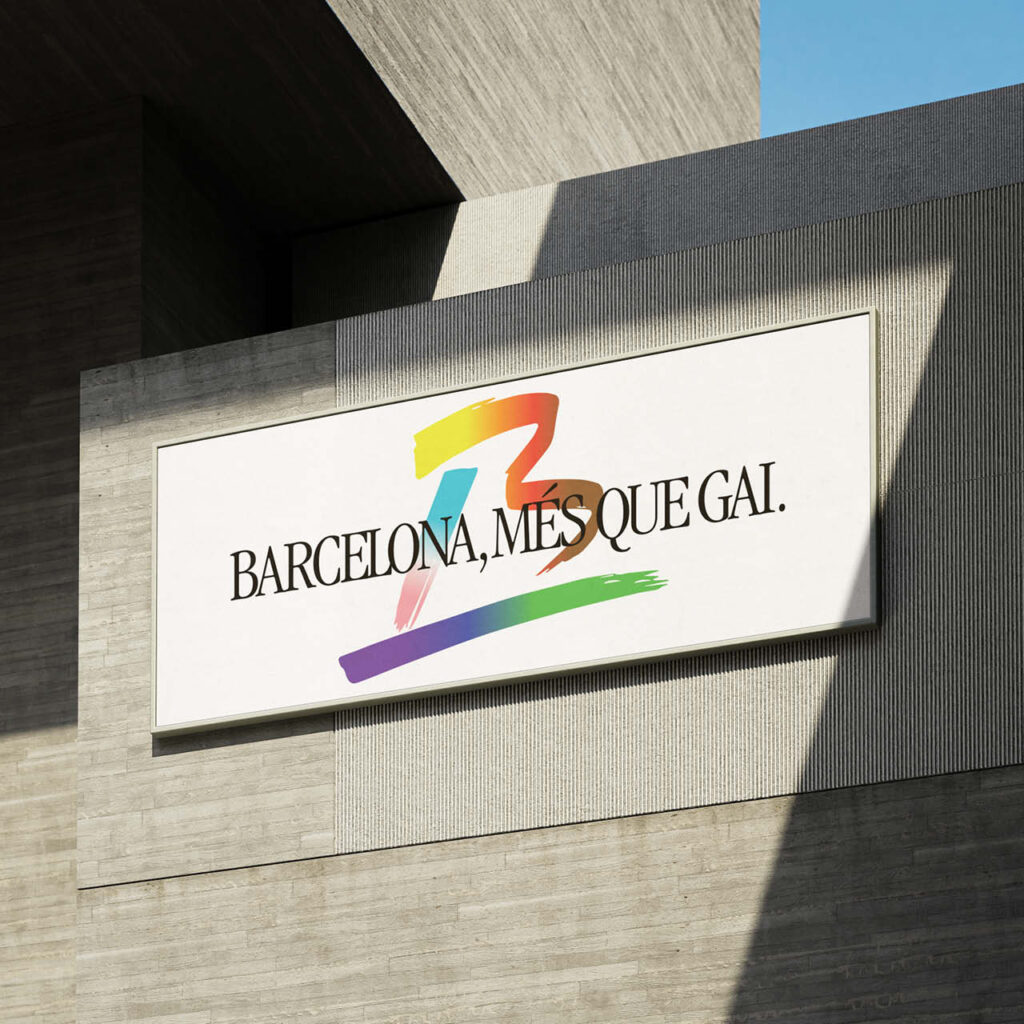
The visual system operates as a modular, scalable language. The gradients derive from the New Progress Pride Flag and from studio research conducted in 2024 (prideflows.org), evolving into four main gradients that, when layered, subtly form the B of Barcelona. The integrated arc references the historical symbol of the movement and introduces direction and motion. Typography and composition draw from protest poster culture, combined with hand-lettering that brings gesture and voice. Black-and-white photography reinforces the link to 1977 and anchors memory in the present.
The system expands across posters, banners, neighbourhood applications, municipal communication and physical pieces such as fans designed to circulate through public space and bodies. Although the proposal was never implemented, it aimed to act as a civic declaration: a Barcelona that not only welcomes, but takes a stand —a city that defends the freedom to be as collective urgency and shared pride.
The campaign was ultimately not implemented, as the Ajuntament de Barcelona chose to pursue a different narrative direction, one that diverged from the original proposal and offered no space for further development. In response to this shift, the Toormix team unanimously decided to step away from the project, in alignment with our vision and with the campaign’s original intent.
Video: José Romero